
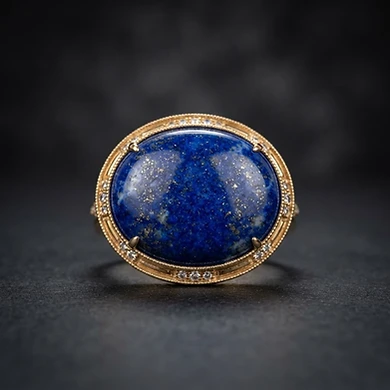
Long before diamonds and sapphires captured the modern imagination, an opaque, celestial rock commanded the veneration of emperors, high priests, and master artisans across the ancient world. Known as lapis lazuli—from the Latin lapis, meaning stone, and the medieval Latin lazulum (derived from Persian lāžward)—this regal blue treasure has adorned humanity for over 6,500 years. Reminiscent of a star-strewn midnight sky, top-tier lapis lazuli pairs deep ultramarine blues with dusting flecks of brassy pyrite, embodying a grandeur that few gems can rival.
The Gemological Anatomy of a Rock Aggregate
Unlike single-crystal mineral gemstones such as ruby or emerald, lapis lazuli is a metamorphic rock composed of multiple distinct minerals. The visual drama and physical presence of lapis depend entirely on the delicate balance of this geological ensemble:
- Lazurite: The foundational mineral and a member of the sodalite group, lazurite is a complex sodium-calcium-aluminum silicate rich in sulfur. It is lazurite's unique sulfur charge transfer that yields lapis lazuli's signature velvety royal blue to deep violet-blue hue.
- Calcite: Typically appearing as white streaks, veins, or patches, calcite is the host rock matrix. High concentrations of calcite degrade the stone's saturation and diminish its value.
- Pyrite: Dispersed iron disulfide crystals introduce metallic, golden inclusions. When subtly scattered across the surface like distant stars, pyrite elevates the stone's artistic allure and authenticity.
- Secondary Minerals: Minor constituents may include sodalite, diopside, amphibole, feldspar, and mica.
From a gemological perspective, lapis lazuli registers a modest 5 to 6 on the Mohs hardness scale. Because it is an aggregate rock, it possesses no uniform crystal system (though individual lazurite crystallites within belong to the isometric/cubic system). It features an aggregate refractive index typically around 1.500 to 1.522, a specific gravity ranging from 2.50 to 3.00 (averaging 2.75), and an uneven to granular fracture with a waxy to vitreous luster.
Antiquity to the Renaissance: The Sacred Azure Thread
The provenance of lapis lazuli is intrinsically woven into the dawn of civilization. Archaeological records reveal lapis beads and amulets in Mehrgarh and Bhirrana dating back beyond the 7th millennium BCE. The primary historical lifeline for fine lapis was the remote, treacherous Sar-i-Sang deposit in the Badakhshan province of northeast Afghanistan—a deposit that Marco Polo documented in the 13th century and which has operated continuously for over six millennia.
In Ancient Egypt, lapis lazuli was regarded as a sacred link between the earthly and divine realms. Pharaohs and high priests considered the blue stone an earthly manifestation of the heavens and truth itself. Famous artifacts, such as the funerary regalia of Tutankhamun, prominently feature masterfully carved lapis lazuli inlaid in royal collars, scarabs, and the famous solid gold death mask alongside carnelian and turquoise. In Mesopotamia, Babylonians and Sumerians fashioned exquisite cylinder seals, royal jewelry, and palace ornaments from Badakhshan lapis.
During the European Middle Ages and Renaissance, lapis lazuli crossed maritime trading routes into Venice—an arrival celebrated as oltramarino ("from beyond the sea"). Ground, purified, and mixed with pine resin, mastic, and wax through labor-intensive levigation, the stone yielded genuine ultramarine. This brilliant pigment resisted fading and surpassed gold in cost per ounce, reserved exclusively for the sacred draperies of the Virgin Mary in works by Titian, Masaccio, and later Johannes Vermeer in masterpieces like Girl with a Pearl Earring.
Global Provenance and Quality Assessment
While Afghan deposits remain the gold standard, lapis lazuli is sourced from several key geographic regions worldwide:
- Badakhshan, Afghanistan: Widely regarded as the source of the world’s finest material. Afghan lapis typically features deep, uniform, highly saturated violetish blue with virtually no visible white calcite and subtle, balanced specks of golden pyrite.
- Lake Baikal, Russian Federation: Mined in Siberia, Russian lapis features pronounced medium to dark blue tones, often accompanied by complex calcite veining and dispersed pyrite.
- The Andes, Chile: Chilean lapis lazuli exhibits a significantly paler, grayish or greenish-blue tone with abundant, prominent white calcite matrix bands, rendering it less sought-after for high jewelry, though popular for artisanal carving.
- Other Localities: Minor deposits occur in the Pamir Mountains of Tajikistan, Myanmar, Canada, and Colorado in the United States.
The Collector's Lens: Connoisseurship and Buying Advice
For collectors and investors of high-end, responsibly sourced gems, evaluating natural lapis lazuli requires a discerning eye:
Color Saturation and Matrix Purity: Value ascends rapidly with purity of color. Premier specimens show an intense, velvety royal blue or indigo with zero white calcite contamination. While delicate, shimmering constellations of pyrite enhance historical appeal and verify natural origin, excessive pyrite produces dull, greenish undertones, decreasing aesthetic and investment value.
Treatments and Simulants: Lower-grade, highly calcitic rough is frequently dyed blue or impregnated with colored polymers to artificially heighten hue and conceal white patches. Natural lapis can also be sealed with colorless paraffin or natural resin to improve luster and stabilize porosity. In the collector space, untampered, natural rough that has received no dye or stabilization represents the highest tier of collectible interest. Discerning buyers must also differentiate natural lapis from reconstituted stones, dyed jasper ("Swiss lapis"), sodalite, and the well-documented synthetic "Gilson imitation lapis."
Care and Longevity: Due to its Mohs hardness of 5 to 6 and slight natural porosity, lapis lazuli demands deliberate care. Fine lapis cabochons, carved watch dials, and beads should never be subjected to ultrasonic, steam cleaners, or household acids, which dissolve calcite inclusions and pit lazurite. Instead, preserve its historic luster with a dry or slightly damp micro-fiber cloth.
The Eternal Appeal of True Blue
Across thousands of years of human civilization, few gemstones have retained their mystique and cultural reverence quite like lapis lazuli. From ancient royal sarcophagi along the Nile to the bespoke watch dials of modern haute horlogerie, lapis remains the definitive stone of timeless sovereignty. For the luxury collector seeking an intimate, authentic connection to deep antiquity, pristine untreated lapis lazuli is not merely an ornament—it is a fragment of history itself.
