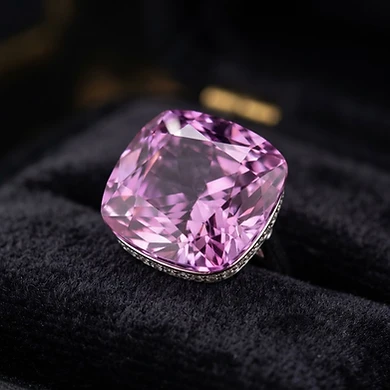
In an era where high-profile colored gemstones such as ruby, sapphire, and emerald frequently command prohibitive market premiums, sophisticated collectors are directing their attention toward undervalued treasures of exceptional pedigree. Among the most alluring of these is kunzite, the delicate violet-to-pink variety of the pyroxene mineral spodumene. Named after legendary Tiffany & Co. gemologist George Frederick Kunz, who first brought it to prominence following its identification in Pala, California, kunzite marries historical luxury provenance with crystalline elegance. For modern connoisseurs seeking both aesthetic brilliance and long-term portfolio diversification, high-grade kunzite presents an intriguing investment narrative.
Gemological Anatomy: The Science of Spodumene
To evaluate kunzite as a viable investment asset, one must appreciate its unique crystal chemistry and physical characteristics. Kunzite is a lithium aluminum silicate with the chemical formula LiAlSi2O6, crystallizing in the monoclinic crystal system. Its soft lilac to vivid purplish-pink color is caused by trace inclusions of manganese (Mn3+) substituting within the crystal matrix.
Key gemological parameters of investment-grade kunzite include:
- Mohs Hardness: 6.5 to 7, offering respectable surface durability for evening jewelry and bespoke collector mounts.
- Cleavage: Perfect cleavage in two directions, intersecting at nearly right angles, which demands consummate lapidary skill during faceting and setting.
- Refractive Index: 1.660 to 1.676, delivering a lively, vitreous brilliance when expertly proportioned.
- Pleochroism: Pronounced dichroism, showing deep pinks or purples along the crystal’s c-axis and paler or nearly colorless tones when viewed perpendicular to the growth direction.
- Clarity Grade: Predominantly Type I; fine gem-quality rough naturally yields stones that are loupe-clean or virtually free of visible inclusions.
Because kunzite crystals often develop in giant pegmatite formations, they can yield extraordinary faceted specimens measuring dozens or even hundreds of carats with pristine clarity. However, this mineral demands careful stewardship: prolonged exposure to intense sunlight and radiant heat can cause the color of untreated or irradiated material to fade, earning it the affectionate moniker of the ultimate “evening gem.”
Market Origins: Provenance and Rarity
While San Diego County, California, remains the romantic benchmark of historic discovery, the contemporary supply of top-tier investment kunzite originates from high-altitude pegmatite fields worldwide. Leading modern localities include the remote Hindu Kush valleys of Afghanistan (notably the Nuristan and Kunar provinces) and the Gilgit-Baltistan region of Pakistan. Afghan crystals are celebrated for their electric, vivid magenta-pink saturation and dramatic dichroism.
Significant commercial deposits also thrive in Minas Gerais, Brazil, as well as Madagascar, Myanmar, and Mozambique. Unlike gems where geographic origin heavily dictates pricing (such as Kashmir sapphires or Colombian emeralds), kunzite is largely judged on its intrinsic optical merit. In the luxury tier, stones presenting unenhanced, saturated purplish-pink hues without overt zoning command the highest market premiums regardless of origin.
The Investment Thesis: Asymmetry, Scale, and Value Potential
From an asset-allocation perspective, kunzite exhibits rare market asymmetry. The vast majority of commercially available kunzite exhibits pale, almost imperceptible tints, often changing hands at modest valuations. However, genuine investment-grade kunzite—characterized by rich magenta saturation, master-tier lapidary execution, and certified untreated status—occupies an entirely different echelon.
Several factors support an appreciating outlook for top-tier specimens:
- Accessible Scale in Haute Joaillerie: High-end fashion houses and independent bespoke ateliers frequently require magnificent statement stones weighing 20, 50, or over 100 carats. Top-quality kunzite allows collectors to secure substantial, eye-clean carat volume without the exponential multi-million-dollar barrier found in pink diamonds, tourmalines, or fine morganite.
- Lapidary Artistry and Value-Add: Because kunzite possesses sensitive cleavage planes, cutting large rough into intricate fancy shapes, deep cushions, or Portuguese cuts requires master craftsmanship. Exceptional faceting that orients the deepest hue through the table elevates a stone from a raw commodity into an irreplaceable work of fine art.
- Supply Volatility: The prime mountainous pegmatites of Afghanistan and Pakistan face recurring logistical, political, and climatic hurdles. Any supply chain constriction directly tightens the availability of saturated, clean rough, driving upside potential for existing curated inventory.
Connoisseur’s Acquisition and Buying Guidelines
When curating kunzite for a high-value collection or long-term investment vault, adherence to disciplined buying criteria is essential:
Prioritize Vivid Saturation: Avoid washed-out, faint pastels. Seek stones with deep rose, lilac, or vivid purplish-pink coloration that remain vibrant even under low evening light conditions.
Insist on Independent Certification: Kunzite can be subjected to irradiation followed by gentle thermal treatment to induce or deepen pink coloration, though this color may revert over time. Procure stones accompanied by reputable laboratory reports (such as GIA or SSEF) certifying natural color and identifying any treatment markers.
Select Protective Architecture: Due to its cleavage characteristics, kunzite intended for jewelry must be set into protective mountings—such as substantial bezel frames, galleries with raised prongs, or brooches and pendants rather than everyday high-impact rings.
Conclusion
Kunzite occupies an elite, poetic niche in the luxury gem marketplace. With its romantic legacy, captivating pleochroism, and ability to yield vast, flawless crystal architecture, it appeals directly to collectors who prize visual drama backed by mineralogical pedigree. By selecting vivid, certified, untreated specimens of significant carat weight, discerning investors position themselves to benefit from the growing appreciation of this spectacular American-heritage gemstone.