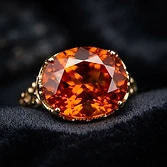
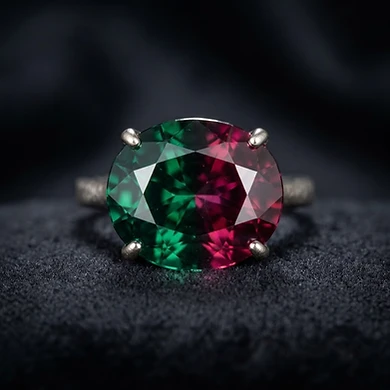
Often immortalized as “emerald by day, ruby by night,” natural alexandrite stands among the rarest, most captivating treasures of the mineral kingdom. First unearthed in the emerald mines of the Ural Mountains during the 1830s, this phenomenal gemstone was named in tribute to the future Russian Tsar Alexander II. Beyond its historical romance and imperial prestige, alexandrite represents an extraordinary geological paradox—a crystallization that demands the convergence of two geochemical elements that almost never coexist in nature.
The Geological Miracle: Mineralogy and Gemological Profile
Alexandrite is the chromium-bearing, color-change variety of chrysoberyl. Its primary chemical formula is beryllium aluminum oxide (BeAl2O4). Under normal crustal conditions, beryllium resides in continental, silica-rich pegmatites, whereas chromium is concentrated within ultra-mafic, mantle-derived rocks. Only when deep tectonic movements bring these diametrically opposed geochemical environments into direct, shearing contact can alexandrite crystallize.
Key physical and optical characteristics include:
- Chemical Composition: BeAl2O4 with trace substitutions of Cr3+ (chromium), Fe (iron), and Ti (titanium)
- Crystal System: Orthorhombic, frequently exhibiting cyclic twinning and pseudo-hexagonal forms
- Mohs Hardness: 8.5, offering superb resistance to scratching and everyday wear
- Toughness & Cleavage: Excellent toughness with distinct to indistinct cleavage planes, ensuring exceptional durability
- Optical Character: Biaxial positive with pronounced trichroism (displaying green, yellow-orange, and purple-red across differing crystallographic axes)
The famed “alexandrite effect” is not caused by pleochroism, but rather by chromium ions selectively absorbing yellow wavelengths within a narrow spectral band. In daylight or fluorescent illumination rich in blue-green wavelengths, the gem transmits a luscious green or bluish-green. When exposed to incandescent or candlelight rich in red wavelengths, the stone shifts dramatically to warm tones of raspberry, purple, or deep ruby red.
Historic and Modern Localities: Mapping the World’s Deposits
Because the geochemical conditions required for its synthesis are so improbable, commercial deposits of alexandrite across the globe are exceptionally sparse. Origin fundamentally shapes color saturation, crystal size, and historical premium:
- Russia (Ural Mountains): The historic benchmark for all alexandrite. Discovered along the Tokovaya River, Russian material set the international standard with its vibrant grass-green daylight hue and incandescent purplish-red shift. While these historic mines have been largely exhausted for generations, fine Russian estate pieces from the Victorian era remain legendary benchmarks in luxury auction rooms.
- Brazil (Minas Gerais & Hematita): Discovered in the late 1980s, the Hematita deposit in Minas Gerais yielded stones rivaling fine Russian gems. Brazilian alexandrite is celebrated for its sharp, high-contrast color shifts—often from an electric teal or blue-green by day to an intense magenta-purple under incandescent light. However, clean rough yielding faceted gems above one carat remains extraordinarily rare.
- Sri Lanka (Ceylon): Revered for yielding historically significant, larger crystals, Sri Lankan alluvial gravels produce gems that often exceed multiple carats. Ceylon stones commonly showcase a characteristic olive-to-forest green under daylight, shifting to a warm brownish-red or bronze-wine tone under incandescent lamps.
- East Africa (Tanzania & Madagascar): Notable deposits in southern Tanzania (such as Tunduru and Manyara) and Madagascar yield attractive material. These African gems offer strong clarity and medium-to-large sizes, frequently transitioning from khaki or bluish-green to rich pinkish-red or purple.
- India (Andhra Pradesh & Odisha): Indian alexandrites are characterized by bright, mint-green to yellowish-green hues changing to reddish-violet, usually appearing in smaller carat sizes with high transparency.
Market Insights and Investment Perspective
In high jewelry and fine gemstone investment, alexandrite occupies an elite echelon alongside untreated ruby, emerald, and fancy colored diamond. While commercial color-change chrysoberyls display muddy shifts between brownish-greens and brownish-yellows, true alexandrite demands a distinct, verifiable transition between green and red-spectrum hues.
Valuation is determined primarily by the percentage and contrast of the color change. A 100% distinct transition between vivid blue-green and pure raspberry red commands an exponential premium over a weak or desaturated shift. Furthermore, because rough crystals rarely survive above minuscule dimensions, price curves escalate dramatically past the 1.00-carat milestone; a top-grade 3-carat natural alexandrite represents an institutional-grade rarity.
For discerning connoisseurs and collectors, third-party certification from globally recognized laboratories (such as GIA or SSEF) is non-negotiable. Top laboratories rigorously evaluate trace-element profiles to distinguish natural alexandrite from synthetic corundum, flame-fusion spinels, and flux-grown chrysoberyls, while accurately verifying geographical provenance.
Conclusion: The Ultimate Chameleon for Connoisseurs
Alexandrite remains the ultimate celebration of geological fortune. Its rare genesis, outstanding durability at 8.5 on the Mohs scale, and spellbinding dual personality make it one of the most intellectually compelling and financially resilient gemstones on earth. Whether procured from historic Russian estates or modern ethical mines in Brazil and East Africa, an untreated natural alexandrite is more than an adornment—it is a breathtaking testament to the rare, transformative beauty of nature.