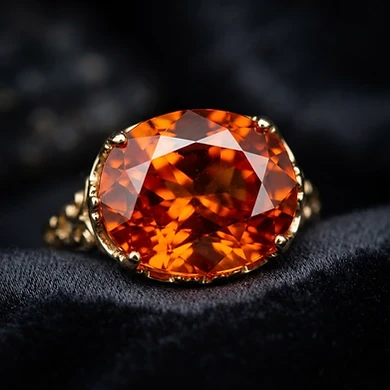
Among all colored gemstones, few possess the electric vivacity and natural brilliance of spessartite garnet. Unadorned by artificial heat treatments or chemical enhancements, fine spessartite delivers a pure, unadulterated flame ranging from radiant marigold to rich reddish-orange. Long considered an obscure mineral curiosity for academic collectors, this fiery gem underwent a dramatic renaissance over the past few decades, ascending to the high jewellery ateliers of Place Vendôme and the private collections of discerning connoisseurs worldwide.
The Science Behind the Sparkle: Gemological Properties
Spessartite is an idiochromatic silicate belonging to the garnet group, specifically serving as an end-member of the pyralspite (pyrope-almandine-spessartine) solid solution series. Its saturated, spectral orange color is intrinsic to its chemical composition, originating from the essential presence of manganese.
- Chemical Composition: Manganese aluminium silicate, Mn₃Al₂(SiO₄)₃
- Crystal System: Cubic (isometric), typically forming dodecahedral or trapezohedral habits
- Hardness: 7.0 to 7.5 on the Mohs scale
- Refractive Index: High, typically 1.790 to 1.820 (often testing over the limit of standard refractometers)
- Specific Gravity: 4.12 to 4.20
- Optic Character: Singly refractive (isotropic), often exhibiting anomalous double refraction (ADR)
- Luster: Vitreous to sub-adamantine
Because garnets are singly refractive, spessartite does not split light into polarized rays. Combined with its remarkably high refractive index and high dispersion (0.027), expertly faceted stones exhibit a crisp, fiery scintillation that rivals fine fancy sapphire.
Geographic Origins: From Bavarian Forests to African Deserts
The variety was named after its historic type locality in the forested Spessart mountains of Bavaria, Germany, where it was classified in the early 19th century. While historical European occurrences were primarily of academic interest yielding small, cloudy crystals, modern discoveries altered the landscape of luxury gemology forever.
Namibia: The Legendary Kunene Deposits
In the early 1990s, an extraordinary find along the Kunene River in northwestern Namibia brought spessartite into the global luxury spotlight. The Namibian rough yielded stones of an unprecedented, neon pure orange tone, quickly christened Mandarin garnet. Sourced from pegmatitic dykes in an arid wilderness, these gems became legendary for their electric saturation. Although original primary deposits proved limited and are now largely depleted, Namibian origin remains the gold standard for pure, unclouded orange hues.
Nigeria: The Oyo and Jos Finds
By the late 1990s, another major deposit emerged in Nigeria, notably around the Oyo and Jos regions. Nigerian deposits produced larger crystals with magnificent clarity, often displaying shades ranging from warm mandarin to deep reddish-apricot due to higher trace iron (almandine) content. Nigerian spessartites expanded market availability and demonstrated that eye-clean gems above 5 carats were achievable.
Madagascar, East Africa, and Global Sources
In subsequent years, Madagascar established itself as another vital source of fine-quality spessartite, producing striking stones that bridge brilliant yellow-orange with rich amber-red. Notable gem-grade occurrences are also mined in Mozambique, Tanzania, Kenya, Brazil, Sri Lanka, and historic pegmatites within the United States (such as the Little Three Mine in Ramona, California). Each locality imparts subtle variations in chemistry, producing a palette influenced by the exact balance of manganese and iron.
Market Insights, Clarity, and Investment Perspective
As an unenhanced, completely natural gemstone, spessartite fits the ethos of modern fine collectors seeking untampered beauty. However, evaluating fine spessartite requires nuanced understanding:
- Color Superiority: The pure "Mandarin" hue—an electric, vivid orange free from brownish or muddy undertones—commands the highest price per carat. Secondary red tones can be intensely attractive, but stones tilting into dark, iron-dominated brownish hues command lower market valuations.
- The Clarity Challenge: Spessartite is inherently classified as a Type II gemstone. Delicate wavy, feathery liquid inclusions and fine rutile needles are customary. Consequently, completely eye-clean specimens—particularly those exceeding 3 to 5 carats—are exceptionally scarce and trade at steep premiums.
- Size and Carat Weight: While sub-two-carat spessartites are readily accessible, fine, unclouded specimens above 5 carats exhibit an exponential price curve. Investment-grade stones beyond 10 carats represent true museum-class rarities.
Conclusion: The Eternal Flame
Spessartite garnet offers a singular harmony of scientific complexity, captivating geographic origin, and unabashed optical brilliance. Free from the artificial heat treatments that dominate much of the luxury corundum market, each stone is a snapshot of Earth's volatile geochemistry, captured in crystal form. For high jewelry collectors and connoisseurs who prioritize rarity, durability, and vivid natural chromatic power, spessartite garnet remains a premier choice among modern colored gemstones.