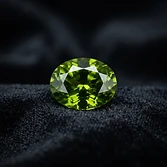
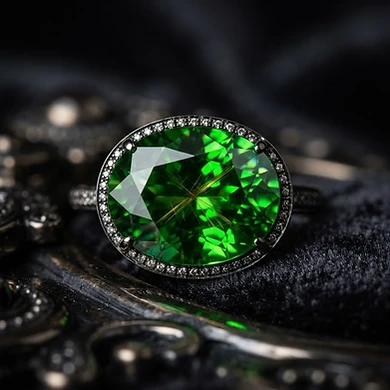
Among elite collectors and gemological connoisseurs, few gemstones command the quiet reverence reserved for demantoid garnet. Named after the Old German word demant, meaning "diamond-like," this vivid green wonder is not merely an alternative to emerald; it is an optical marvel in its own right. With a dispersion that exceeds diamond and a historical association with imperial royalty, demantoid holds a unique and prestigious position in the luxury gemstone market.
The Gemological Anatomy of Demantoid
Demantoid is the rare, chromium-rich green variety of andradite, an iron-calcium member of the broader garnet species. From a mineralogical perspective, demantoid exhibits extraordinary physical and optical properties:
- Chemical Composition: Ca3Fe2(SiO4)3 (Calcium Iron Silicate), with vivid green hues imparted by trace quantities of chromium (Cr3+) and occasionally ferric iron.
- Crystal System: Isometric (Cubic), commonly presenting as dodecahedral or trapezohedral habits.
- Mohs Hardness: 6.5 to 7.0, granting moderate durability suitable for high-end bespoke jewelry, though protective settings are recommended for rings.
- Refractive Index: Exceptionally high at 1.888 to 1.895, giving it intense brilliance.
- Dispersion: 0.057—surpassing diamond’s 0.044. This remarkable fire splits white light into dazzling prismatic flashes, especially visible in lighter to medium tones.
First unearthed in Russia's central Ural Mountains along the Bobrovka River in the mid-19th century, demantoid quickly captured the devotion of Peter Carl Fabergé and the Russian imperial court. Although significant deposits have emerged in Namibia (discovered in the late 1990s) and Madagascar (2009), classical Russian Ural stones remain the quintessential pedigree in the international trade.
The Market Value Equation: Color, Origin, and the 'Horsetail' Paradox
Valuing demantoid requires an understanding of traditional 4Cs alongside specific mineralogical idiosyncrasies that defy standard gemstone grading norms:
Color Saturation and Tone: The finest investment-grade demantoid showcases an electric, intense emerald-green with uniform saturation and absence of dark extinction or overt brown undertones. Stones with lighter yellowish-green shades may exhibit stronger visible dispersion, but pure vivid green commands the highest prices per carat.
The Horsetail Inclusion: In almost every other colored gem, visible inclusions detract from market value. In Russian demantoid, the opposite is true. Radiating fibrous inclusions of chrysotile (serpentine) or bisso-amphibole—poetically referred to as "horsetails"—are celebrated. A gracefully centered, golden spray not only serves as diagnostic proof of Russian origin but can dramatically elevate a specimen's valuation among collectors.
Carat Weight Scarcity: True gem-quality demantoid is inherently small. Rough rarely yields clean cut stones over 1 carat. A top-grade 2-carat demantoid is far rarer than a comparable emerald or sapphire, triggering an exponential price increase once the stone crosses the 1.00, 2.00, and 3.00-carat thresholds.
Current Market Trends and Investment Perspective
Over the past two decades, demantoid has transformed from a niche collector's oddity into a sought-after blue-chip asset. Commercial-grade gems (often smaller, lighter yellowish-green Namibian material) typically trade between $300 and $1,500 per carat. However, investment-grade Russian material displaying intense green color and signature horsetails consistently realizes between $3,000 and $10,000+ per carat, with extraordinary 3+ carat gems surpassing $20,000 per carat at major auction houses such as Sotheby’s and Christie’s.
Several dynamics reinforce its investment appeal:
- Depleted Classic Sources: Original alluvial deposits in the Urals produce dwindling quantities of top-tier rough, tightening global supply.
- Unheated Authenticity: Unlike sapphires, rubies, or tanzanite, high-value demantoid is generally unheated and untreated, appealing to investors seeking completely natural treasures.
- Institutional Demand: High jewelry ateliers in Paris, Geneva, and New York frequently incorporate demantoid into one-of-a-kind masterworks, sustaining continuous demand.
Connoisseur Buying Advice
For collectors considering demantoid garnet as an alternative asset or bespoke heirloom, proper due diligence is critical. Always insist on independent gemological reports from world-renowned laboratories such as GIA, SSEF, or GRS to authenticate natural origin and verify that no undocumented enhancements are present.
Prioritize cutting quality: because demantoid possesses extraordinary dispersion, precision lapidary work—such as round brilliant or custom cushion cuts—is essential to unlocking the gem's signature fire without light leakage. When acquiring Russian material, evaluate the horsetail inclusion under magnification to ensure it does not compromise structural integrity while enjoying its status as nature's microscopic signature.
Conclusion
Demantoid garnet bridges historical romance with scientific brilliance. As a store of value, its uncompromising scarcity in sizes above one carat, coupled with finite primary sources, positions it as an exceptional long-term hold. For the discerning investor, acquiring an untreated Russian demantoid is not merely an investment in a mineral specimen, but the acquisition of an enduring masterpiece of the natural world.