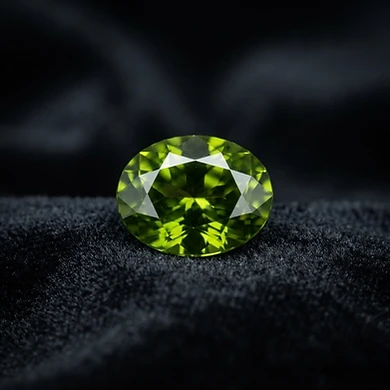
Historically celebrated by the ancients as the “gem of the sun” and christened by the Romans as the “evening emerald” for its uncanny ability to retain a luminous, incandescent green under candlelight, peridot holds a singular station in the universe of fine gems. While commercial-grade specimens are widely accessible, premier fine-jewelry and investment-grade peridots are extraordinary rarities that command profound appreciation from high-jewelry ateliers and discerning collectors alike.
The Anatomy of Olivine: Gemological Foundations
Peridot is the gemological variety of olivine, an essential rock-forming silicate mineral with the chemical composition (Mg, Fe)&sub2;SiO&sub4;. Crystallizing within the orthorhombic crystal system, peridot exhibits a vitreous to slightly greasy luster and possesses a hardness of 6.5 to 7 on the Mohs scale. This structural resilience renders it suitable for bespoke pendants, earrings, and cocktail rings, provided settings are designed to cushion the gem against harsh abrasion.
What sets peridot apart gemologically is its idiochromatic nature: its color is intrinsic to its core chemical matrix rather than caused by trace impurities. The mineral’s vivid green hue is generated by iron within its crystalline lattice. In addition, peridot possesses pronounced birefringence (0.036), typically measured with a refractive index between 1.64 and 1.69. Under a loupe or gemological microscope, this strong double refraction is readily evident, creating a distinctive optical doubling of facet junctions that imbues the gemstone with a velvety, shimmering visual depth.
Value Drivers: The Four Cs and Provenance Premiums
In high-end valuation, the market price of peridot is dictated by a rigorous interplay of color saturation, optical purity, cut precision, and geographic origin:
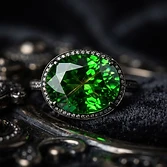
- Color Saturation: The pinnacle of value belongs to gems presenting an intense, grass-to-olive green without overt yellowish, brownish, or gray undertones. Excess iron deepens brown modifiers, dragging valuations downward, while balanced chemistry yields the electrifying electric-lime to forest green prized by connoisseurs.
- Clarity and Purity: Fine peridot should be eye-clean. While microscopic chromite crystals, discoid “lily-pad” stress fractures, and tiny droplet-like inclusions are common diagnostic features, stones destined for investment portfolios demand crisp internal purity without milky turbidity.
- Carat Weight Non-Linearity: While 1- to 3-carat stones are relatively plentiful, peridots exceeding 5 carats are dramatically rarer, and exceptional stones surpassing 10 to 20 carats command substantial exponential premiums per carat.
- Geographic Provenance: The market awards prestige to historic and premier mining localities. The storied island of Zabargad (St. John’s Island) in Egypt represents the historic apex of ancient collections. In modern luxury circles, high-altitude alpine deposits in Suppatt, Kohistan (Pakistan) and the gem gravels of Mogok, Myanmar (Burma) produce the most vividly saturated, large-format crystals known to the trade. High-yield commercial sources in China and Arizona supply mass luxury, but rare Kashmiri and Burmese specimens capture the crown.
Market Pricing Dynamics and Investment Potential
From an investment standpoint, peridot occupies a compelling segment within colored gemstones. Untreated by nature—unlike sapphires or rubies, which routinely undergo thermal enhancement—peridot on the luxury market is almost universally unheated, offering an authentic organic appeal increasingly sought by purists.
Commercial and medium-grade peridots (AA) in smaller carats typically trade between $30 and $70 per carat. However, top-tier (AAA) eye-clean gems ranging from 3 to 5 carats readily fetch $70 to $120 per carat, while museum-quality stones exceeding 5 carats regularly ascend to $150 to $200+ per carat. Master-cut, historically documented Burmese or Pakistani showpieces scaling above 15 carats enter an elite bespoke bracket where pricing is negotiated stone-by-stone based on rarity and aesthetic magnificence.
The Collector's Perspective: Curation and Care
When curating peridot for a private collection or bespoke commission, prioritize precision-faceted stones that maximize fire and mask pavilion extinction. Ensure the gemstone is accompanied by an independent report from an internationally accredited laboratory such as the GIA to substantiate natural origin and freedom from synthetic substitutes or glass fillings.
Because peridot is susceptible to thermal shock and harsh chemicals, clean exclusively with warm soapy water and a soft brush—avoiding ultrasonic cleaners and steam processing. Handled with reverence, a fine natural peridot remains one of the gem world’s most vibrant, historically resonant, and undervalued treasures of the earth.