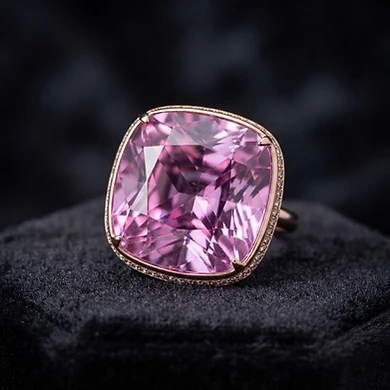
Elegantly poised at the intersection of modern gemological discovery and high-jewelry romance, kunzite is one of the most enchanting pastel treasures in the realm of fine gemstones. Celebrated for its delicate dance between blush pink and shimmering violet, this magnificent variety of spodumene offers collectors an extraordinary combination of exceptional clarity, sizeable crystal potential, and captivating optical phenomena. First recognized in 1902 in the Pala region of San Diego County, California, and named in honor of legendary gemologist George Frederick Kunz of Tiffany & Co., kunzite quickly captured the imagination of discerning connoisseurs worldwide.
The Gemological Profile of Kunzite
From an earth science perspective, kunzite is the lithium-bearing pink-to-violet variety of the pyroxene mineral spodumene, sharing its mineral lineage with rare green hiddenite and yellow triphane. Kunzite crystallizes in the monoclinic crystal system, forming prismatic, deeply striated crystals within lithium-rich granitic pegmatites. Its signature coloration—ranging from subtle petal pink to deep, regal lilac—is imparted by trace elements of trivalent manganese (Natural Gemstones Buying Guide).
- Chemical Composition: LiAlSi2O6 (Lithium Aluminum Silicate) (GIA Kunzite Gemstone Guide)
- Mohs Hardness: 6.5 to 7.0
- Refractive Index: 1.660 – 1.676
- Specific Gravity: 3.18
- Optical Character: Biaxial positive with pronounced dichroism/pleochroism and strong phosphorescence under ultraviolet stimulation (GIA Kunzite Gemstone Guide, Gemstones.com)
A signature optical hallmark of kunzite is its intense pleochroism. When viewed from different crystallographic axes, a single gem can exhibit deep lilac, light pink, and virtually colorless tones. To showcase maximum color intensity, master lapidaries must orient the facet table perpendicular to the c-axis—a delicate procedure complicated by the mineral’s two directions of perfect cleavage (GIA Kunzite Gemstone Guide).
Evaluating Quality: Color, Clarity, Cut, and Carat
When curating kunzite for a high-jewelry collection or luxury acquisition, understanding the four foundational pillars of colored gemstone grading is paramount:
Color: Color remains the preeminent value driver. While pale baby-pink crystals are relatively abundant, specimens possessing rich, vivid purplish-pink or saturated orchid tones command significant premiums (Natural Gemstones Buying Guide). The most coveted stones exhibit saturated, uniform color distribution without appearing washed out in ambient light.
Clarity: Unlike emeralds or rubies, fine-quality kunzite is celebrated for its type-I clarity profile. Discerning collectors should demand high transparency and eye-clean perfection (Natural Gemstones Buying Guide). Internal veils, inclusions, or feathering disrupt light transmission and jeopardize structural integrity along its natural cleavage planes.
Cut and Proportions: Kunzite requires expert faceting. Because rough material is often lightly saturated across broad planes, cutters frequently use deeper pavilions, step cuts, or tailored cushion and emerald silhouettes to concentrate depth of color. Precise symmetry and optical alignment ensure vivid brilliance rather than "windowing" in the center.
Carat Weight: Spodumene pegmatites frequently yield large, pristine rough crystals, allowing kunzite to be faceted in substantial carat weights rarely seen in pink sapphires or spinels (GIA Kunzite Gemstone Guide). While a 10-carat sapphire is exceedingly rare, kunzite effortlessly offers statement sizes of 15, 30, or even 50+ carats with pristine clarity, making it a favorite for theatrical cocktail pieces.
Notable Global Sources and Market Nuance
While historically rooted in Southern California’s Stewart and Pala pegmatite mines, modern high-grade kunzite originates from a select few geological frontiers:
- Afghanistan & Pakistan: The pegmatite fields of the Hindu Kush—most notably in Nuristan, Afghanistan—produce what many gemologists consider the gold standard of kunzite, celebrated for deep purplish saturation and monumental clarity (Natural Gemstones Buying Guide, Gemstones.com).
- Brazil: The prolific gem valleys of Minas Gerais yield impressive, gem-quality crystal formations known for soft blush and crystalline rose hues (Natural Gemstones Buying Guide).
- Madagascar: Madagascar produces fine crystals characterized by bright pastel tones and superb clarity (Natural Gemstones Buying Guide).
From an investment standpoint, fine unheated kunzite displaying intense natural saturation presents an intriguing value proposition. While gentle thermal enhancement or irradiation is occasionally employed in the trade to coax pink tones from brownish spodumene, completely natural, untreated stones supported by an independent gemological laboratory report (such as GIA) maintain the greatest collector prestige and long-term liquidity.
Styling and Preserving "The Evening Gem"
Kunzite is famously nicknamed the “Evening Gem.” This evocative title reflects both its romantic ambiance under candlelight and an essential conservation practice: prolonged exposure to intense ultraviolet light or direct sunlight can gradually cause its color to fade over time (Gemstones.com).
Furthermore, because spodumene features two directions of perfect prismatic cleavage alongside a hardness of 6.5 to 7.0, conscious setting design is critical (GIA Kunzite Gemstone Guide, Natural Gemstones Buying Guide). Kunzite shines brilliantly in pendant necklaces, brooch artistry, and dramatic drop earrings, where it avoids direct impact. When commissioned as a cocktail ring, it is best framed within protective halos of diamonds or secured with bespoke bezel architectures. Clean kunzite solely with warm, soapy water and a soft-bristled brush; ultrasonic and steam cleaners should strictly be avoided.
Conclusion: An Ethereal Addition to Fine Collections
With its luminous presence, romantic color palette, and distinguished American gemological heritage, kunzite remains one of the most sophisticated colored gemstones available. For the collector seeking substantial scale, pristine transparency, and an ethereal violet-pink brilliance, kunzite delivers an unmatched statement of elegance in the world of high jewelry.